A $110 Million Contract: How to Avoid Getting Scammed in the USA — a Case, a Scheme, and a Solution
The essence of the matter
The essence of the matter
In the autumn of 2024, a company registered in Georgia approached us. On the surface it seemed like a standard commercial request: problems with equipment delivery from the United States. A closer look revealed that this was not a local dispute at all, but a large-scale transnational conflict. The Georgian company had partner entities and subsidiaries in Belarus and the United Kingdom through which deliveries were also being made. All payments and contractual relationships led to a single American firm registered in Miami, Florida.
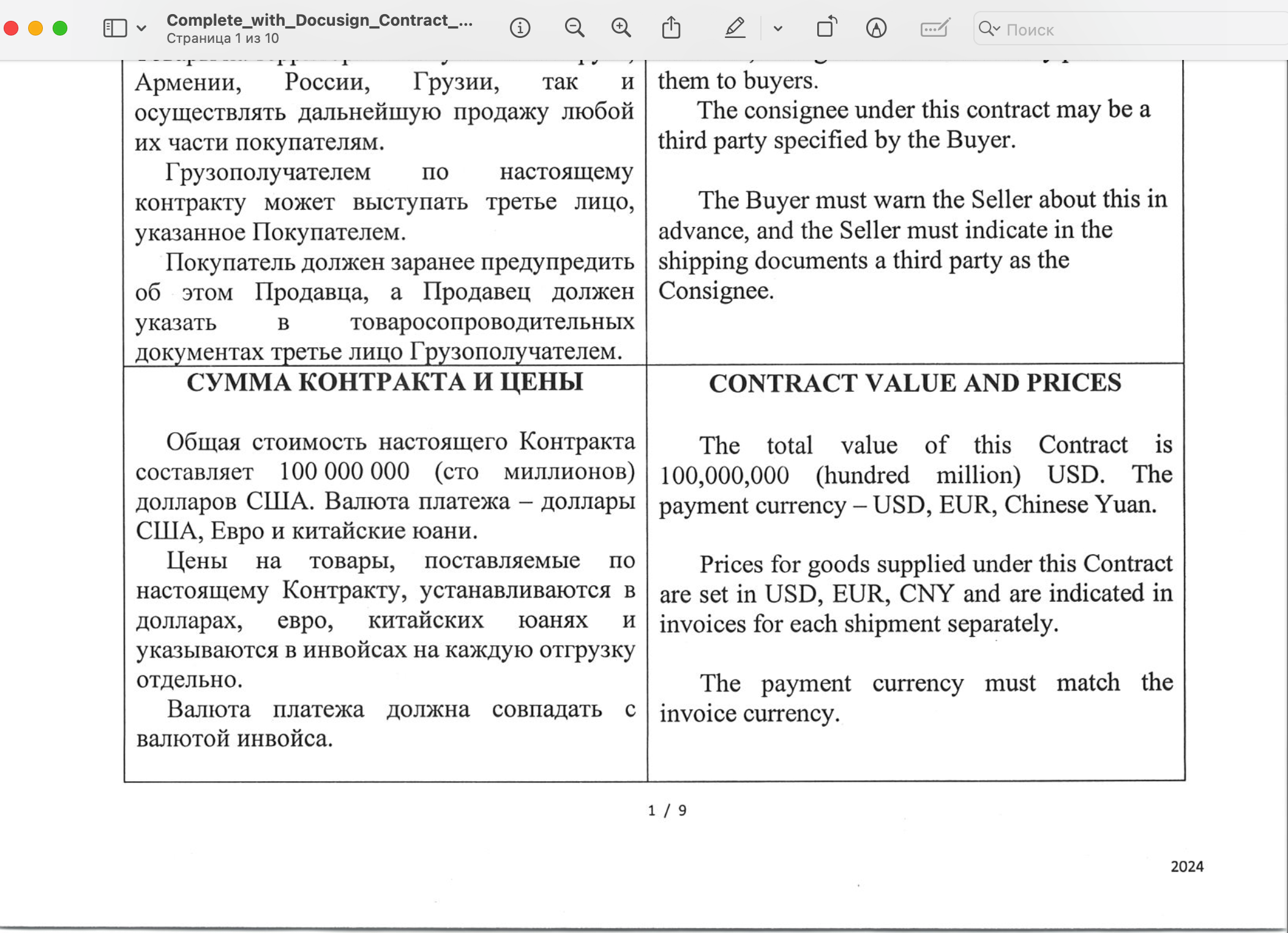
The total contract value for the envisaged deliveries was $110 million, confirmed by signed contracts, payment orders, and correspondence between the parties.
At the time of the approach, significant sums had already been paid under three separate arrangements:
Belarus: under a multi-million-dollar supply contract, more than $1,250,000 had been paid, yet goods worth only approximately $120,000 were delivered. A $15,000 refund was made as compensation for delays, after which all cooperation effectively ceased.
Georgia: a contract for $200,000. No goods were delivered at all; an invoice was issued, payment was made, and then came delays and attempts to substitute goods without agreement.
United Kingdom: an invoice payment of $62,000 was made without a signed contract. The payment is confirmed; no delivery was made. Documents purporting to show a refund raised well-founded doubts.
In total, more than $1.5 million had been paid for equipment that was never delivered, accompanied by unconvincing explanations and frankly questionable documents.
Legal review
Our legal review and analysis allowed us to build a complete picture of the counterparty's activities in the United States. We ran queries through professional databases, cross-referenced publicly available court records, consulted federal and district registries, and traced the financial and corporate footprint of the company and its beneficial owner. We established that the head of the American firm had previously been involved in several criminal and administrative proceedings — including criminal prosecutions for fraud, money laundering, driving under the influence, tax violations, and civil litigation involving unpaid debts, contract breaches, and commercial equipment disputes.
Furthermore, the materials we obtained revealed that in the course of one criminal case, investigators had uncovered a fictitious supply structure, forged documents, and attempts to evade liability by registering new legal entities. We also established that over the preceding several years, dozens of court claims had been filed against entities linked to the respondent.
Our team produced a legal opinion on each episode, covering: which legal norms were violated; what recovery options were available through US courts; how judgments from other jurisdictions (such as Georgia) might be domesticated; and where the key legal vulnerabilities lay for parties caught in the scheme. We also assessed the prospects of filing private criminal complaints and engaging US law enforcement, including at the federal agency level. All of this formed the foundation of our strategy for restoring our clients' rights.
Pre-trial work in the USA
Everything began with pre-trial work. As part of the pre-litigation settlement procedure, formal demand letters were sent to the American company for each episode — with the amounts claimed, calculations, copies of contracts, and proof of payment. The demands were prepared by a licensed US attorney in accordance with civil procedure requirements and served by courier at the company's address in Miami-Dade County. After receiving the demands, the supplier made contact and proposed a series of remote negotiations to 'clarify details' and 'find a compromise.'
Several conference calls took place involving attorney Artur Kuznetsov, US colleagues, and representatives of the Georgian company and its lawyers. We gave the other side an opportunity to explain the situation and proposed flexible pre-trial settlement options — instalments, partial refunds, and other compromise arrangements. However, every argument during the negotiations boiled down to one claim: he had been 'deceived' by logistics partners. He maintained that the fault lay not with him but with 'partners in Dubai, Armenia, Turkey,' that 'the goods were held up,' that 'the invoices were not in his favour,' and that 'he was himself a victim of the scheme.' Each time he assured us that 'everything would be resolved tomorrow,' 'shipment would happen on Monday,' or 'just one more week is needed to clarify things.'
Negotiations lasted several weeks, but the respondent took no real steps. Neither goods nor money were returned. It became increasingly clear that the tactics of delay and deflection of responsibility onto 'third parties' were part of a pre-planned scheme. At that point we recorded the fact of a refusal to voluntarily perform obligations and commenced preparations for litigation.
Litigation strategy across four jurisdictions
Following the conclusion of the pre-trial stage, we proceeded to build a multi-layered litigation strategy tailored to the specifics of each episode. Since payments had originated from three separate legal entities — from the United Kingdom, Georgia, and Belarus — we pursued three parallel procedural routes, adapting the legal instruments to the circumstances of each case.
First direction — the UK company's case. In this episode, an invoice for $62,000 was paid but no shipment ever took place. During pre-trial negotiations the respondent presented a forged confirmation of a refund via TD Bank, which we treated as a direct element of fraud. We therefore decided to file in a US federal court (Southern District of Florida), as such cases fall under federal court jurisdiction and, where fraud is established, the court may award treble damages. We increased the claimed amount to $100,000, including compensation, interest, and punitive damages.
However, the federal court declined to accept the case, holding that in the absence of a written contract — with only an invoice available — the claimed losses were speculative in nature. The court refused to count moral damages and punitive sanctions towards the jurisdictional threshold ($75,000) and dismissed the complaint on formal grounds.
Following the federal court's refusal, we prepared a new package of documents to file a complaint with the Florida state court (Circuit Court). This was a logical continuation of the strategy: state courts impose no minimum claim requirement, and such cases are considered on the merits when the evidence is in order, regardless of the amount of loss.
However, state court does not allow punitive damages to be claimed through a simplified procedure as in federal court. This means it is significantly harder to increase the claim by characterising the respondent's actions as fraudulent: a separate court order is required, intent must be proven, a special motion must be filed, and in some cases an ongoing criminal proceeding must already exist.
Filing in the state court is therefore a tactical, though limited, path — aimed at obtaining a stable judgment on the principal debt without attempting to expand the claim through complex and hard-to-prove categories of loss. We chose this path to provide our client with a clear, reliable, and above all workable means of protecting their interests.
Second and third directions — the Georgian and Belarusian company episodes. In those cases, signed international contracts existed, confirmed by bilateral correspondence, payments, and account details. We decided to proceed through Georgia's national jurisdiction, filed a claim in the arbitration court, and have already obtained a judgment for debt recovery. The next step is the domestication (recognition and enforcement) of the Georgian court's ruling in the United States, including within Florida's jurisdiction. This process proceeds under specialised rules for international recognition of judgments, and the relevant documents will shortly be submitted to a US court.
The strategy was therefore not designed as a templated legal escort service, but as a flexible, multi-step, cross-border legal construct encompassing pre-trial negotiations, risk analysis, filings in multiple jurisdictions, recognition of foreign judgments, and parallel protection of the client's interests through three different legal systems.
What this means for business — and what conclusion to draw
This story is not merely a one-off case. It reflects a systemic error that many companies make: trusting without checking, paying without documenting, and entering international transactions without engaging international lawyers before a conflict arises. The result: millions in losses, years of litigation, multiple jurisdictions, and a great many remedial steps that could have been avoided.
Legal support for supply transactions is not about 'verifying after the goods don't arrive.' It is about not paying in the first place when goods are not going to arrive.
Checking a counterparty — its ownership history, corporate structure, active proceedings, criminal record, tax obligations — can be done in 48 hours. The cost is a fraction of the potential loss. The risk is reduced by an order of magnitude.
Due diligence is not a formality. It is insurance.
International legal planning is not a privilege of corporations. It is a necessity for any business that operates across borders.
We continue to work on this matter, coordinating efforts in the USA, Georgia, and Europe.
To be continued…
How to verify a counterparty in the USA, EU, or Asia
If you work with foreign partners or are planning to do so — do not neglect counterparty verification. We support clients in the USA, EU countries, the CIS, Asia, and the Middle East, providing information from professional databases, court registries, corporate registers, and other sources.
If you need to verify a supplier, client, counterparty, or simply an acquaintance operating abroad — in the USA, the UK, Germany, Turkey, the UAE, China, or in more than 30 other jurisdictions — please get in touch.
We will gather the information that so often proves decisive — before the loss occurs.
Further materials on the case are available via the link below.
Article images